Sunday, June 3, 2018
Eastern Red-backed Salamander
I have often been "accused" of taking too long on nature walks. Stopping to look under a rotting log. Pausing to explore under a moss-covered rock. Lingering to see what treasures hide in the leaf litter at the base of a tree.
While this poking and prodding has cost me a few relationships, the rewards have generally outweighed the losses. (I mean who wants to hang out with someone who doesn't like exploring the life found under logs, rocks and leaf litter?)
Had I not stopped to search under the bark of a decaying Birch tree, I would not have happened upon this Eastern Red-backed Salamander (Plethodon cinereus) -- and a few bugs, spiders, earthworms, centipedes, pill bugs, ants and all sorts of molds and fungi...
Thursday, May 24, 2018
Yellow Warbler
I have been trying to take more bird photographs. But, that has involved learning to use new equipment and techniques. By the time I get set up to take a picture, it seems that the bird in question is long gone. The learning curve seems quite steep...
This Yellow Warbler (Setophaga petechia), however, seemed to be either very patient or very curious. As I fumbled with various knobs and buttons on my camera and lens, he seemed to become more interested in -- or maybe more amused by -- the proceedings.
Sunday, May 20, 2018
Wood Anemone
I walk the trail in my backwoods more days than not. I have been walking it on and off for almost two decades. I feel as though I know every nook and cranny. I feel as though I have seen everything it has to offer.
Then, coming around a small bend. At the base of a tree I have past hundreds of times. Something new...
A cluster of Wood Anemone (Anemone quinquefolia) or Wood Windflower has bloomed.
Has it bloomed there before and I just missed it? Has it bloomed in other parts of the backwoods and I just didn't notice?
I make another loop around the trail - venturing off on little side trips - to see if I can find more of it. All I can find is its cousin, Canadian Anemone or Canada Windflower. A flower that I have seen every spring for as long as I can remember.
Why the new arrival? Has something changed that has brought it into these woods.
Thursday, May 17, 2018
Dekay's Brown Snake
Until today, I had never crossed paths with a Dekay's Brown Snake (Storeria dekayi). I had been looking for several years, but with no luck. I can now cross it off "my list".
When I encounter a new species, I feel a certain obligation to create and / or add to a list of the species I have seen. But I am not a list maker.
Keeping lists of the things I observe stresses me out. Do I start my list moving forward? Do I try to remember all the species I have seen? Do I include only species I have seen in Vermont? Do I include species I have seen in exotic places like Iceland, St. John's or Eastern Long Island?
I, inevitably, start to feel like a need a list of lists -- ferns, fungi, lichen, plants, insects, birds, reptiles, amphibians, mammals... I will never see them all -- so what is the point?
For me, focusing on the lists detracts from experiencing the interaction.
So, I have decided to just keep a mental "rolodex" of species I have seen. A constant process of meeting new friends and re-crossing paths with old friends.
Monday, May 14, 2018
Spring Beauty
The forest floor is covered with Spring Beauty.
There are two varieties of Spring Beauty. The round-leaved Spring Beauty (Claytonia caroliniana), that is common. And the narrow-leaved Spring Beauty (Claytonia virginica), that is more rare.
My goal is to see if I can find the rare one. But, no such luck today.
Will have to settle for the beauty of the common spring beauty. Life is tough...
Thursday, May 10, 2018
Hepatica
I can not believe how quickly spring is passing by.
The coltsfoot and bloodroot have passed. Only a few Sharp-lobed Hepatica (Anemone acutiloba) flowers remain. White, blue and yellow violets are coming into bloom. Dandelions cover the lawn.
The trees and the grass become more and more green each day. Summer is just around the corner.
Tuesday, May 8, 2018
White Trillium
In the shadows of the spring forest, the White Trillium (Trillium grandiflorum) are making their grand entrance.
Sunday, May 6, 2018
Icelandic (Atlantic) Puffin
My guess is that you will never see an Atlantic Puffin (Fratercula arctica) in Vermont...
I had the pleasure of spending the past two weeks traveling around the back roads of Iceland. And, travel in Iceland brings whole new meanings to the words "around" and "back roads".
Bits of spring intermixed with winter snowstorms... Full sun one second, blizzard conditions the next. Then back to full sun like nothing happened.
Days, that at this time of the year, start at at 5 AM and end at 10 PM (although it never really does get dark).
Fjords, glaciers, lava fields, geysers, mud pots, black pebble beaches, snow capped mountains, water falls and hot springs...
Reindeer, seals and arctic fox... Whooper swans, pink-footed geese, ptarmigan, oyster catchers, fulmar, eider ducks, and all sorts of other upland and coastal birds... And, of course, puffins
Suffering from a bit of "sensory underload" at the moment. But, spring has sprung in Vermont. So, lots of things to see and explore.
Saturday, April 14, 2018
American Sycamore
I have been walking around the woods looking for yet undiscovered vernal pools and the salamanders and frogs that inhabit them. No such luck today...
So, I head off to see an old friend -- an American Sycamore (Platanus occidentalis). I have visited this tree many times before. Maybe to gaze upon its beautiful bark -- large silver-gray flakes peeling away to reveal soft-white and tan-brown underbarks. Maybe it is to find last years hand-sized leaves, now pancake-brown, dry and crunchy. Maybe it is to find a seed pod lying on the soft moss. Maybe it is something else...
I have only "known" two American Sycamores in my life. Seeing this one reminds me of the other -- a massive tree that shaded my backyard growing up. Standing next to this one conjures up memories -- good and bad -- of my childhood. Trees have a way of doing that...
Monday, April 2, 2018
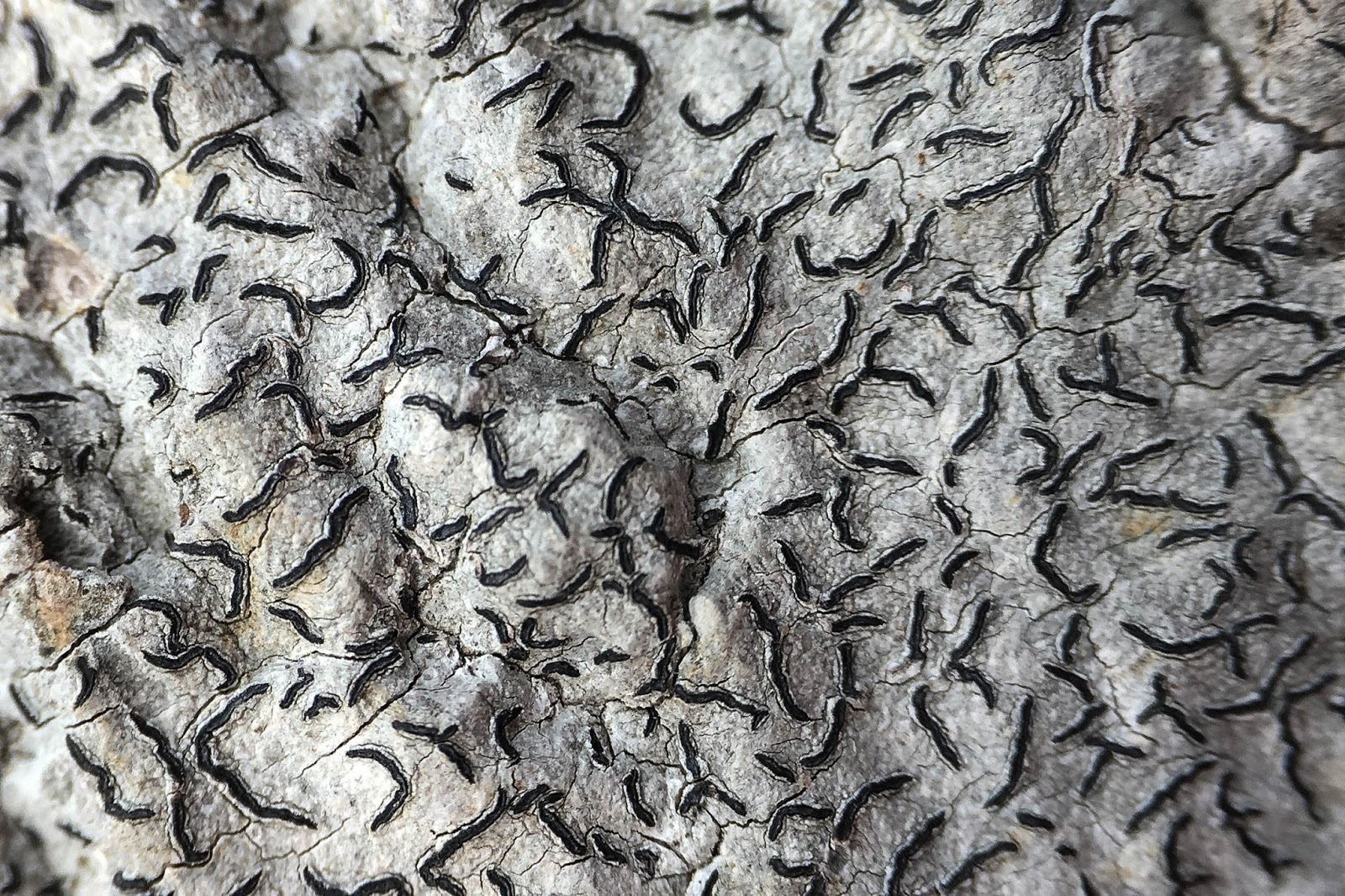
Script Lichen
As I walk up the trail, a maple stands lost among the other trees in the forest. For no particular reason, I head in its direction.
With each step, it fills more of my field of view until I must crane my neck up and down to see from its base to its crown. Walking still closer, I am lost under the branches of its leafless canopy. A body's length away, I can see the wrinkles and folds of its aging bark. At arms length, it appears as if someone has splattered gray mud on the side of the tree.
Moving as close as I can to the trunk of the tree -- my nose almost touching the bark as I try to focus my hand lens, I find that the mud is not mud at all. Black, squiggly lines reveal that what I thought was mud, is actually Script Lichen (Graphis scripta) or Secret Writing Lichen.
What other wonderful worlds would I have found if I had chosen a different tree? Or, if I had looked 5 or 6 inches to the right or left?
[A special thanks to Christian Schorn of the UVM Field Naturalist Program who introduced me to this lichen on a recent field walk. And, to Sean Beckett of the North Branch Nature Center who taught me how to take a really close up picture using my field lens and iPhone.]
Wednesday, March 28, 2018
Pussy Willows
It has taken a long time for me to come out of hibernation this year.
I am not sure if it is because there is still snow covering large portions of the ground. Or because I still need my microspikes to go walking on the ice-covered trail in the backwoods. Or because a cold wind seems always to be blowing from the north.
But much has already happened this spring. Geese have been flying north. Arctic Buntings have been stopping at the roadsides. Red Wing Black Birds have been mobbing the bird feeders. Killdeer have started showing up in the fields. None of these seemed able to pull me out from under the comforter.
Today, however, I could see the Pussy Willows (Salix discolor) blooming at the edge of the wet area in the corner of the yard. Spring is here! Time to get up and at 'em...
Tuesday, July 18, 2017
Common Yellow Wood Sorrel
Common Yellow Wood Sorrel (Oxalis stricta) goes by a variety of names. Lemon Clover, Sourgrass, and Pickle Plant. Names describing the sour taste one experiences when they chew on the leaves.
This weekend, I learned another name -- "vinegars". Evidently it is or was common for youngsters to sit in a lawn and chew on the leaves to get a tangy taste treat. The original Sour Patch Kids.
Thursday, July 13, 2017
Common Drone Fly
The daisies are in full bloom at the south side of the house. And, they appear to be covered with honey bees. Which I think is a good thing, given the state of honey bees in the world.
However, on closer inspection, most of these "bees" are not bees at all. They are Common Drone Flies (Eristalis tenax) -- one of the bee mimics.
Drone flies have evolved to look like male honey bees (drones). And, they have even evolved to fly like honey bees -- methodically moving from flower to flower rather than hovering like other flies.
Surveying the visitors to the daisies, it is hard to distinguish the bees from the drone flies. Honey bees have narrower waists than drone flies -- a characteristic difficult to discern at an arms length.
Best to give both the bees and drone flies a little distance. I wish to avoid the sting from the true honey bees.
Thursday, July 6, 2017
Silver Spotted Skipper
I was trying to photograph wildflowers. A Silver Spotted Skipper (Epargyreus clarus) had other ideas.
Known to be "inquisitive", these butterflies will investigate any intruder that ventures into their territory.
As I sat on the ground trying to focus on the berries of a Red Baneberry, this butterfly kept landing closer and closer to me.
If butterflies and humans could communicate, a conversation would have gone something like this...
SSS - "What are you doing?"
CLH - "Photographing wildflowers."
SSS - "Why not take a picture of me?"
CLH - "Because I am taking pictures of wildflowers. And, as soon as I try to focus on you, you will flutter off."
SSS - "No I won't. Look I'll get closer."
CLH - "Stop! You're distracting me!"
SSS - "How about this?", it said moving even closer.
CLH - "Go away!"
SSS - "How about now?", moving even closer.
CLH - "Go pester someone else!"
SSS - "I'll stay perfectly still. I promise."
CLH - "Ughhh. Ok. Ready." I positioned myself to get a picture. Click. Click.
It was gone.
Sunday, July 2, 2017
Land snail on mushrooms
Do you think we have had enough rain?
The average precipitation for our area in the month of June is four inches. Over seven inches fell this past month. And, most of that rain fell in the last two weeks of the month.
While we may be less than thrilled about the amount of rain. It has created a wonderland for slugs, snails and mushrooms.
However, maybe even this land snail had had enough of the rain and took refuge on the top of these mushrooms...
(I was unable to positively identify the snail and the mushroom. If you have thoughts, let me know)
Thursday, June 29, 2017
Devil's Paintbrush
The color palette of the woods has become mostly shades of green. To come upon a cluster of Devil's Paintbrush (Hieracium aurantiacum) almost hurts the eyes!
It also goes by the name Orange Hawkweed. Interestingly, that name was given by the Roman naturalist Pliny who proposed that the flowers were eaten by hawks to strengthen their eyesight.
Tuesday, June 27, 2017
Daring Jumping Spider
Each day when I went to the mailbox, a Daring Jumping Spider (Phidippus audax) would be waiting to greet me as I reached in to grab the mail.
It had become routine. I would carefully open the metal door of the mailbox a pinch. The spider would be sitting just inside - usually at one of the corners where the door, walls and floor met. As the light from the opening door crossed over its many eyes, it would jump across the stack of mail and disappear into a crevice.
One day, I opened the door. No spider. That is, until I got into the house and found it sitting between two pieces of junk mail.
Under the indoor light, I had an opportunity to see the intricate "tree" or "face" pattern on its back and the beautiful iridescent blue-green of its mouth parts.
While some people actually keep Daring Jumping Spiders as pets, I felt we were both better off with it guarding the mailbox.
Sunday, June 25, 2017
Yellow Slant-line Moth
The universe was acting like a minimalist painter when it chose the coloration of the Slant-line Moths. The Yellow Slant-line Moth (Tetracis crocallata) -- a solid dark-brown line with two distinct black spots. The White Slant-line Moth -- just the dark line.
Wednesday, June 21, 2017
Harnessed Tiger Moth and Hickory Tussock Moth
I was working late at night at the dining room table. It was dark outside and the June Beetles were buzzing and hitting against the screens. The dog could not decide what side of the door she wanted to be on.
Her whining grew to a point where I finally got up to let her out. I opened the door. She just stood there looking up at me. She was now certain which side of the door she wanted to be on. And, all sorts of flying things had made the same decision.
Back at the table, a moth fluttered around the overhead lights in chaotic circles. Suddenly it dropped down onto a piece of paper right in front of me. I slowly grabbed my camera to get a picture of a Harnessed Tiger Moth (Pantesis phalerata).
Moths are a favorite food of bats. However, Harnessed Tiger Moths evidently taste bad and they make clicking sounds while they fly. Thus, the bats quickly learn that they will get a less than pleasant meal if they choose a Harnessed Tiger Moth.
The next morning, while I was surveying the windowsills in search of other insects that had made it through the door the previous night. I came upon a Hickory Tussock Moth (Lophocampa caryae).

I wasn't able to get pictures of the myriad mosquitoes that buzzed around my head all night long...
Sunday, June 18, 2017
Common Cinquefoil
One of the first flowers I encountered when I moved to Vermont was the "Five Toes". I found them in the backyard, in the meadows and in the back woods.
I have just come to realize that "Five Toes" is not a flower, but a family of flowers. And, that there are five common types of "Five Toes" found in Vermont. Trying to sort them all out has been a bit of a challenge. I have also realized that it pays to get a little closer to the ground and to have a really good wildflower key.
Today as I was walking in the woods, I found this member of the "Five Toes" family -- the Common Cinquefoil (Potentilla simplex). It was not the same as the ones I had seen before.
I will have to wait a few more weeks for the Sulfur Cinquefoil to appear.
Wednesday, June 14, 2017
Arctic Skipper
Yesterday, the back yard was filled with Yellow Swallowtail Butterflies, Black Swallowtail Butterflies and Monarchs. On long, easy wing beats, they traveled an invisible highway that ran along the rick-rack fence. They did not stop or tarry, but traveled the length of the fence and were gone. It seemed that they were headed to some distant destination.
Today, the imaginary highway was being traveled by Arctic Skippers (Carterocephalus palaemon). They, however, were not in a hurry. Like tourists, they turned and returned to every flower, stem and fence post, as if searching for the best place to stop for a bite to eat or a place to rest.
Monday, June 12, 2017
Oxeye Daisy
I am amazed at how quickly the seasons pass.
The Coltsfoot has come and gone. I consider it the first flower of spring. The Dandelions have covered the lawn with yellow. And, now they too have released their fluffy seeds into the wind and disappeared. I consider them the flowers of mid spring.
At the edge of the paths and in the middle of the fields, the Oxeye Daisies (Leucanthemum vulgare) have started to bloom. The first days of summer are upon us.
In the normal ordering of things, the Black-eyed Susan, Chicory and New England Aster will soon arrive in step. Is fall just around the corner???
Wednesday, June 7, 2017
American Toad
I am sitting on the back porch eating lunch when I see something moving in the grass just in front of me. Actually, I don't see the "something", but I do see the grass moving as if a "something" is making its way through it -- snake, mouse, vole? Closer inspection reveals that it is an American Toad (Anaxyrus americanus). It slowly yet purposely climbs onto to the patio stone.
I saw the toad yesterday while it was raining. An earthworm slithered by right under the toad's nose. Just as the earthworm had almost completely disappeared into a crack in the stone, the toad grabbed it by the tail and ate it.
Today, I gently reach down and pick up the toad. It sits in my cupped hand. Slowly breathing, its sides go in and out. It blinks a few times. Then in one swift leap, it is off into the ferns.
Monday, June 5, 2017
Common Yellowthroat
Once again the rain is falling. I am moping around the back yard and woods looking for something interesting to photograph. Other than raindrops on green foliage, not much is catching my eye.
Near the wet corner of the yard where the willows have taken over, there is a sudden commotion. I have stepped across the boundary of the territory claimed by a male Common Yellowthoat (Geothlypis tricha).
The Yellowthroat zips back and forth between the willows and a plum tree in the orchard, passing within a few feet of me each time. Its constant chipping and chirping lets me know that I have intruded just past a point of comfort.
Finally, either tiring or believing that I am not a threat, it settles on a wire just long enough for both of us to gain our composure.
Wednesday, May 31, 2017
Spring Storm
The sky is quickly growing dark and a few splatters of rain begin to hit the windshield. Soon I a driving through a wall of wind, hail and water. Tree branches are sailing across the road. Puddles, deep puddles, are forming almost immediately on the sides and middle of the road. The windshield wipers are going full tilt and I have slowed to a crawl.
While I am in the relative comfort of my car and hopefully, others are in the comfort of the indoors, the animals and plants outside are taking the full force of the storm.
As I drive across the causeway, I wonder about the osprey nesting high atop the power poles and leaf-less snags. In the relative open, they stay protecting eggs or young from those torrential rains, pea sized hail and whipping winds.
The storm passes. The winds and rain abate. The sun returns. A few shakes of the feathers and all is as it was. Or so I hope.
Wednesday, May 24, 2017
Eastern Forktail Damselfies
Over the last few months, I have been struggling with letting the right side of my brain have more of a say in my musings than the left side of my brain. Letting the aesthetic have more say than the logical.
As I was walking along the trail several days ago, I saw a shimmer of color that seemed like darning needles dancing in the mottled sunlight. As I stooped down to get a closer look, I saw delicate damselflies flitting from one plant leaf to another.
With help from friends, I identified these beautiful creatures as Eastern Forktail Damselflies (Ischnura verticalis). The top picture is that of a male. The bottom picture is that of a immature female.
Before, I would have pulled out field guides and searched online to find out more information about these insects -- where are they found, what do they eat, what eats them. This time, I found myself just staring at them -- taking in their colors, noticing the patterns in their wings and appreciating the subtle differences between the two.
I will get to the left brain stuff some other day...
Thanks to Dave Hoag and Bryan Pfeiffer for helping with the identification.
Sunday, May 21, 2017
Six-spotted Green Tiger Beetle
The weather is considerably warmer and the sun is shining on the trail ahead. A brilliantly shiny Six-spotted Green Tiger Beetle (Cincindela sexguttata) is guarding the path. If beetles could speak, I would expect this one to say, "Halt, who goes there"?
As I walk down the path, this half inch speck of iridescent green stands its ground. I walk closer. It retreats five or six feet, turns and faces me, once again standing its ground. This continues until we leave the sunlit patch. The beetle then flies past me, lands, turns and faces me. Again, it dares me to cross its line.
I am not intimidated by this guardian of the forest path. However, were I an ant or other small bug, I would have a hefty respect for the Tiger Beetle's massive mandibles that it uses to defend its territory and to attack and devour its next meal.
Tuesday, May 16, 2017
Cedar-Apple Rust Gall
Warmer air and rain were in the forecast. I did not notice anything unusual on the Eastern Red Cedar (Juniperus virginiana) trees when I pulled out of the driveway. On my return and after a gentle rain had fallen most of the day, it looked as if someone had decorated the cedar trees with tiny, orange starburst-shaped ornaments. The Cedar-Apple Rust Galls (Gymnosporangium juniperi-virginianae) had matured and were setting out spore.
Cedar-Apple Rust is a fungus that spends part of its life cycle on apple and crabapple (Malus spp.) trees and and part of its life cycle on Eastern Red Cedar trees.
When early rains of spring arrive, the Cedar-Apple Rust Galls produce elongated jelly-like horns that produce spores. The spores travel by wind to susceptible apple trees.
The spores attach themselves to undersides of young apple leaves creating orange-red dots. Later in the season, the lesions on the apple leaves produce spores that travel by wind back to susceptible Eastern Red Cedars.
Sunday, May 14, 2017
Killdeer
Six weeks ago while winter was still upon us and the geese were traveling north in flocks, I heard the first cries of the Killdeer (Charardrius vociferus) as they too returned from their wintering grounds. The weather was cold and raw, the ground still frozen and covered in snow in most spots. As the days went on, the chorus of cries grew louder and louder.
The grass has turned green and the Killdeer have been busy finding mates and laying their eggs. Interestingly, Killdeer lay their eggs and then build a nest. They lay their eggs in a suitable shallow depression that they find in lawns, driveways, parking lots and / or closely mowed fields. They then build a simple nest by adding bits and pebbles to the nest site.
One of the pair will tend to the nest while the other searches for food. In 22 to 28 days, the eggs will hatch and the chicks will be off and running.
Tuesday, May 9, 2017
Blue-spotted Salamander
I always consider it a great day when I stumble upon a Blue-spotted Salamander (Ambystoma laterale). I found this one under some old wood that I was cleaning up behind the barn.
A member of the mole salamander family, they are usually found in low wet places including Red Maple/Cedar Swamps -- the dominant natural community of our backwoods.
They are mostly nocturnal -- hiding during the day and feeding during the night. They are carnivores, eating a wide variety of terrestrial and aquatic invertebrates.
When attacked, they secrete a noxious, milky secretion from glands in their tails that leaves a bad taste in the mouths of their predators.
Sunday, May 7, 2017
American Hoverfly
It has been cold and rainy these last few days. I have seen few insects on my morning walks in the back woods. Pulling a layer of decaying bark from the remains of a long dead tree, I find an American Hoverfly (Eupeodes americanus) safely protected from the elements.
I normally encounter these flies on warm summer afternoons as I rest on the front porch. They hover near by as if trying to get a better understanding of me. Now, slowed down by the cooler weather, I have a chance to gain a better understanding of them.
American Hoverflies are common throughout North America -- adults feeding on flower nectar, larvae feeding on aphids. They are considered beneficial insects as they provide natural pest control.
In a slight twist of fate, their black and yellow bands mimic certain wasp species and thus protects from predation from birds. They are, however, prayed upon by certain wasp species.
Wednesday, May 3, 2017
The patch of Dutchman's Breeches (Dicentra cucullaria) covers the entire southeastern slope of the hill. The delicate green foliage is punctuated by splashes of white and yellow. The long white pants with their yellow belts are hanging out to dry.
A cousin of Dutchman's Breeches called Squirrel Corn (Dicentra canadensis) has more rounded pantlegs and a purple belt. To me, it looks more like a old english crown or bonnet (or the head dress of the Dutchess in Alice in Wonderland).
Both flowers can be found in the same area. I searched, but can find no Squirrel Corn in the patch of Dutchman's Breeches.
Dutchman's Breeches and Squirrel Corn are exclusively pollinated by bumblebees. They use ants to disperse their seeds.
Both produce compounds that slow the heart and nervous system. Thus, they are sometimes grouped with other flowers called "stagger weeds" -- as livestock develop the "staggers" from grazing on the foliage.
Sunday, April 30, 2017
Devil's Urn Mushrooms
I have been searching the leaf litter looking for bugs and other crawly things when I stumble upon a cluster of Devil's Urn Mushrooms (Urnula craterium).
Devil's Urns or Crater Cups are one of the first mushrooms to arise in the spring. They grow off fallen hardwood that is decaying on or under the ground. The dark inner surface is the fruiting surface that produces spores.
Devil's Urns produce chemicals that inhibit the growth of other fungi. And, they evidently produce an audible sound when the release their spores.
Thursday, April 27, 2017
Mourning Cloak Butterfly
The Mourning Cloak Butterflies (Nymphalis antiopia) are playing games with me again. It is a beautiful, sunny day as I walk through the spring woods. A small shadow appears on the ground projecting a classic pulse - pulse - glide pattern. A Mourning Cloak Butterfly is nearby. It settles on the dry leaves, gently opening and closing its wings.
I step closer to where it landed and it takes off in a flurry. It circles around and lands in almost exactly the same spot. I step closer and we repeat the game. Finally, I am able to get close enough to catch a photo as it sits in the warm sun. I try once more, but this time I get too close. It flies off having had enough of this fun.
Adult Mourning Cloak Butterflies can over-winter through hibernation, awakening with the warmth of spring and thus getting an early start on mating. The springtime adults feed on tree sap, decaying material and the nectar of spring wildflowers.
There is a tale about the color pattern on the Mourning Cloak's wings. The dark, maroon-brown central portion of the wings resembles a "mourning cloak". Not wishing to be completely moribund, the butterfly has revealed a bit of its pale-tan and brilliantly blue-spotted undergarments that appear at the edge of its wings.
Wednesday, April 26, 2017
Champlain Islands' Nature celebrates 1 year!!!
Hello,
This week marks the one year anniversary of the start of Champlain Islands' Nature!!!
Over 85 posts to date. More on the way.
This year, I have added a few items to the blog.
First, is a tab called "Places to Go". It is a list of places to view wildlife (or just go for a nice walk) in Grand Isle County. I have divided the list by town. I will be adding detailed information about each of the sites over the course of the summer. South Hero is complete.
Second, is a tab called "Bird Checklist". This is a list of the 200 or so most commonly seen birds in Grand Isle County. The list is divided up by bird family -- ducks, hawks, warblers, etc. Within each family, the birds are arranged according to their likelihood of being seen. So, within the sparrows, you are more likely to see a Song Sparrow (common, top of the list) than a Vesper Sparrow (uncommon, bottom of the list).
Third, is a tab called "Bookshelf". This is a list of commonly used resources and a few of my favorite reads. I will be adding to this list as time moves on. On the sidebar, you can see what nature related book(s) is to be found on my nightstand.
And, you can find a link to my ebook -- A Guide to the Wildflowers of Landon Community Trail.
If you receive email notifications about posts, you may need to go to the blog itself to get the above mentioned information. (If you need the link, click here Champlain Islands' Nature)
If you have any comments, questions or suggestions, I would love to hear them. Please send them to ChamplainIslandsNature@gmail.com
Enjoy,
Chuck
This week marks the one year anniversary of the start of Champlain Islands' Nature!!!
Over 85 posts to date. More on the way.
This year, I have added a few items to the blog.
First, is a tab called "Places to Go". It is a list of places to view wildlife (or just go for a nice walk) in Grand Isle County. I have divided the list by town. I will be adding detailed information about each of the sites over the course of the summer. South Hero is complete.
Second, is a tab called "Bird Checklist". This is a list of the 200 or so most commonly seen birds in Grand Isle County. The list is divided up by bird family -- ducks, hawks, warblers, etc. Within each family, the birds are arranged according to their likelihood of being seen. So, within the sparrows, you are more likely to see a Song Sparrow (common, top of the list) than a Vesper Sparrow (uncommon, bottom of the list).
Third, is a tab called "Bookshelf". This is a list of commonly used resources and a few of my favorite reads. I will be adding to this list as time moves on. On the sidebar, you can see what nature related book(s) is to be found on my nightstand.
And, you can find a link to my ebook -- A Guide to the Wildflowers of Landon Community Trail.
If you receive email notifications about posts, you may need to go to the blog itself to get the above mentioned information. (If you need the link, click here Champlain Islands' Nature)
If you have any comments, questions or suggestions, I would love to hear them. Please send them to ChamplainIslandsNature@gmail.com
Enjoy,
Chuck
Wednesday, April 19, 2017
Wood Frog

I have been visiting local vernal pools over the past week looking for signs of spring salamanders and frogs. Amid the choruses of spring peepers I did find one Yellow-spotted Salamander -- but it scrambled under the pond debris before I could get a good look at it. No signs of Blue-spotted or Marbled Salamanders as of yet.
I did come across this Wood Frog (Lithobates sylvaticus) sitting on top of the partially submerged leaf litter. This small brown frog has a characteristic brown-black mask and a call that sounds like a flock of noisy ducks.
A "pond snail" crawls by the frog's right front foot.
Sunday, April 16, 2017
Gray Comma
I realize that I have woefully overdressed as I reach the sunny shores of Lake Champlain. The sun that was hiding behind the clouds is beaming down on the loose cobbles. The cool waves of the lake are lapping upon the shore. Along the water's edge, yellow Coltfoot flowers are spread as fall as the eye can see.
Removing my fleece, I sit quietly in the sun watching to see what visits the flowers. Small bees and bugs move about too quickly to be identified or photographed.
Suddenly, a flash of orange appears and settles on one of the bright yellow flower heads just in front of me. Gently opening and closing its wings, a Gray Comma butterfly (Polygonia progne) has come to feast on one of the first flowers of the spring. It seems too involved in gathering nectar, to notice my presence -- even as I fumble with my camera and kick stones and twigs with my knees and feet.
Tuesday, March 14, 2017
Barred Owl
Winter Storm Stella is howling outside. I can hardly see across the road. As I get up from the table to head to the kitchen, I see something sitting on top of the snow covered grill outside the back door. A Barred Owl (Strix varia) has stopped by to visit.
It seems completely unphased by the wind and the snow -- looking down at the ground and under the porch. It flies back and forth between the grill and the clothesline post as if uncertain as to the best place to sit in the blizzard conditions. Finally, it takes roost in the ash trees at the back tree line. A little while later, I see why is has come so close to the house.
In the area just off the porch, a chipmunk peers out from the snow cover. It looks around as if shocked by a lack of spring. As it scampers across the top of the snow toward the house, the owl breaks into sight and dives talons forward into the snow.
The chipmunk will be able to tell of its brush with death. The owl returns to the branches and shakes the snow off its feathers.
Wednesday, December 7, 2016
Winterberry
The first snows have fallen and the leaves are off most of the trees except for the evergreens. At the edges of the woods, patches of bright red stand out against the early winter browns and grays. The American Winterberry are in fruit.
Winterberry (Ilex verticillata) is a member of the holly family. Unlike its evergreen southern counterpart, the American Holly (Ilex opaca), Winterberry loses it leaves each winter revealing dense red clusters of red berries.
Usually found in wet places, it is the only species of holly native to eastern North America.
Friday, November 18, 2016
Oak Leaves
While there are many, many types of oaks (Quercus spp.), they can be divided into at least two major groups by the shapes of their leaves.
The white oak group has gentle, rounded edges to their leaves (leaf to the left above). In our area, these would include the White Oak, Bur Oak, Chestnut Oak and Swamp Oak.
The black oak group has bristly, pointed edges to their leaves (leaf to the right above). In our area, these would include the Scarlet-Pin Oak, Black Oak, Northern Red Oak and Scrub Oak.
Of course, the bark, buds, twigs and acorns are useful tools for distinguishing the individual species of oaks.
Wednesday, November 16, 2016
Phragmites
The Common Reed (Phragmites australis) is found throughout the world and is for the most part is considered invasive -- although it may have come to the new world long before humans. It is most commonly found in freshwater wetlands and edges of brackish marshes.
Phragmites are able to outcompete other marsh vegetation by blocking sunlight and producing extensive root systems. It also produces two toxins that deter other plants from sprouting.
They do, however, have their good points. They provide excellent habitat for marsh birds. And, they have been used in natural water purification systems and in basket making.
Monday, November 14, 2016
Hornets' Nest
The leaves have fallen off the trees exposing the handy-work of the Bald-faced Hornet (Dolichovespula maculata). These large nests -- made of a paper like material -- can grow to be twelve to eighteen inches across and can house hundreds of hornets and their queen.
As winter approaches, most of the hornet colony perishes. The queen overwinters and starts the colony anew.
Bald-faced Hornets and Yellowjackets are in the same subfamily of insects -- the Vespinae. The Bald-faced Hornets usually build their nest high in trees. Yellowjackets usually build their nests underground.
Both are considered beneficial insects -- eating a wide variety of pest insects. They do become a nuisance when they move too close to our houses and activities.
Wednesday, November 9, 2016
Trumpet Lichen
Even on the dreariest of days, nature always has something to lift the spirit...
Trumpet Lichen (Cladonia fimbriata) is found on moist soil or rotting wood in spaces that receive full or partial sun.
The trumpet or splash cup assists in spreading the lichen's spore which are located in small packets on the end of the trumpet's rim. When the rains fall, the raindrops splash in the cups helping to disperse the spores.
Or, one could imagine tiny imaginary creatures drinking magical brews from these delicate "pixie cups". (True pixie cups are actually a different group of lichens).
Monday, November 7, 2016
Native Freshwater Mussels
The recent foul weather brought large piles of native mussel shells to the sands of White's Beach.
There are fourteen species of native freshwater mussels in Lake Champlain. The most common being the Eastern Elliptio (Elliptio complanata) and the Eastern Floater (Pyganodon cataracta). Eight other members of the freshwater mussel family found in Lake Champlain are either rare, threatened or endangered.
One of the biggest threats to the native freshwater population is the invasive Zebra Mussel. It can overtake native mussel habitat and can kill off large numbers of native mussels by attaching to their shells.
I am not certain what caused the demise of these mussels. If you look carefully, you can also see snail and periwinkle shells.
Friday, November 4, 2016
Butter and Eggs
It is the first week of November, but on my early morning walks, it still seems like late summer or early fall. The roadsides are still dotted with Queen Anne's Lace, Chicory, Red Clover, White Clover, Sweet White Clover, Yellow Hop Clover, White Campion, and a few late Asters and Goldenrods.
And, amid the fading grasses I found several buncehs of Butter and Eggs (Linaria vulgaris). A plant that I usually associate with the hot summer months.
Butter and Eggs is in the snap-dragon family of flowers. It is an excellent food source for bumblebees seeking a late fall meal.
Monday, October 31, 2016
Wooly Bear Caterpillar
Can you really predict the weather from the bands on a Woolly Bear Caterpillar (Pyrrharctia isabella)? Probably not, since a collection of caterpillars in the same year will have varying amounts of brown and black.
But it you want to believe it, the story goes something like this. The amounts of brown and black supposedly indicate the severity of the upcoming winter. More brown, mild winter. Less brown, severe winter.
Looks like we are in for a mild winter... Hmm, October 31st and still no killing frost here in the Islands.
Woolly Bear Caterpillars don't seem to mind either way. They forage until it does freeze. Then they over winter in a frozen state only to wake up again in the spring.
Friday, October 28, 2016
Sticktights
At this time of the year you will probably find your shoes, shoelaces, pantlegs and shirtsleeves covered with Beggar's Ticks after a walk through the woods or an unmown field.
The Beggar Ticks (Bidens frondosa and Bidens vulgata) grow in waste places and disturbed soils. The produce inconspicuous pale-yellow to orange flowers in the late summer and early fall.
They are also known as Sticktights, as their seeds (called achenes), with two tiny spikes (called awns) that are covered with tiny barbs, literally stick tight to everything -- including the fur of animals. This allows the seeds to be transported long distances.
Subscribe to:
Posts (Atom)