Showing posts with label Pelots Point Nature Area. Show all posts
Wednesday, July 6, 2016
Blue Flag
The Blue Flag (Iris versicolor) is a showy iris of the wetlands of the eastern United States and eastern Canada.
While the name "Flag" means rush or reed in middle English, the Blue Flag is actually an iris. The color of its petals can vary from white, to blue, to purple.
While beautiful, the sap from the foliage can cause a skin rash and chemicals in the rootstocks are toxic.
Wednesday, June 29, 2016
Widow Skimmer
The Widow Skimmer (Libellula luctuosa) is common across the United States (except in the Rocky Mountain region). It is a member of the king skimmer family of dragonflies.
The name is derived from the black patches on the wings that are said to resemble the mourning crepe worn by widows (although both males and females have this pattern on their wings).
It is found near still bodies of water including marshes, ponds, and lakes. Males are very territorial -- guarding egg laying females. Eggs are laid just under the surface of the water. Larva (call naiads) live underwater and eat other aquatic insects. They eventually leave the water, molt and emerge as adults.
Adults feed on small insects.
Monday, June 27, 2016
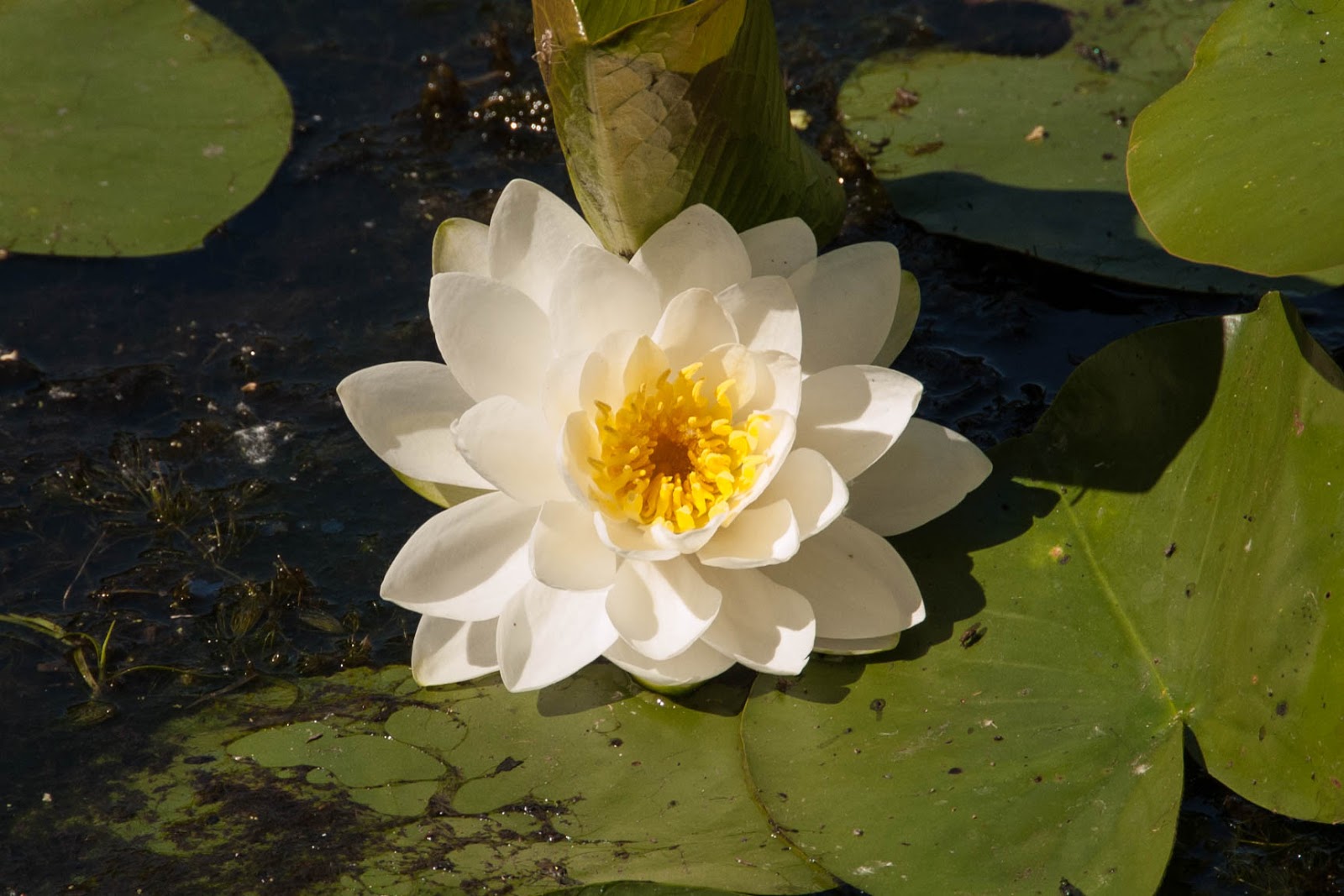
Fragrant White Water Lily
The Fragrant White Water Lily (Nymphaea odorata) is a found in shallow ponds and marshes of North America. And, while commonly called a lotus, the White Water Lilies are in a different genus from the idyllic and symbolic Chinese and Indian lotuses.
The Fragrant White Water Lily has large white or pink floating flowers and round floating leaves that are deeply cut. The flowers open in the morning and close by noon. They are fragrant -- hence the name.
Most of the plant lives underwater. It has branched rhizomes that produce long stems that connect with the floating leaves. The leaves are protected with a water-repellent waxy coating. The stems contain channels that allow for gas exchange between the leaves and the rhizomes.
Sunday, April 24, 2016
Northern White Cedar
The Northern White Cedar (Thuja occidentalis), also commonly known as Arbor Vitae (“Tree of Life”), is a member of the Cupressaceae family – the cypresses. It is not a cedar at all.
It is a very common tree.
It is often found in swamps and on cliffs – tending to grow in areas
where there is little competition from other trees. It is a slow growing and resilient tree and can
be very long lived.
Subscribe to:
Posts (Atom)